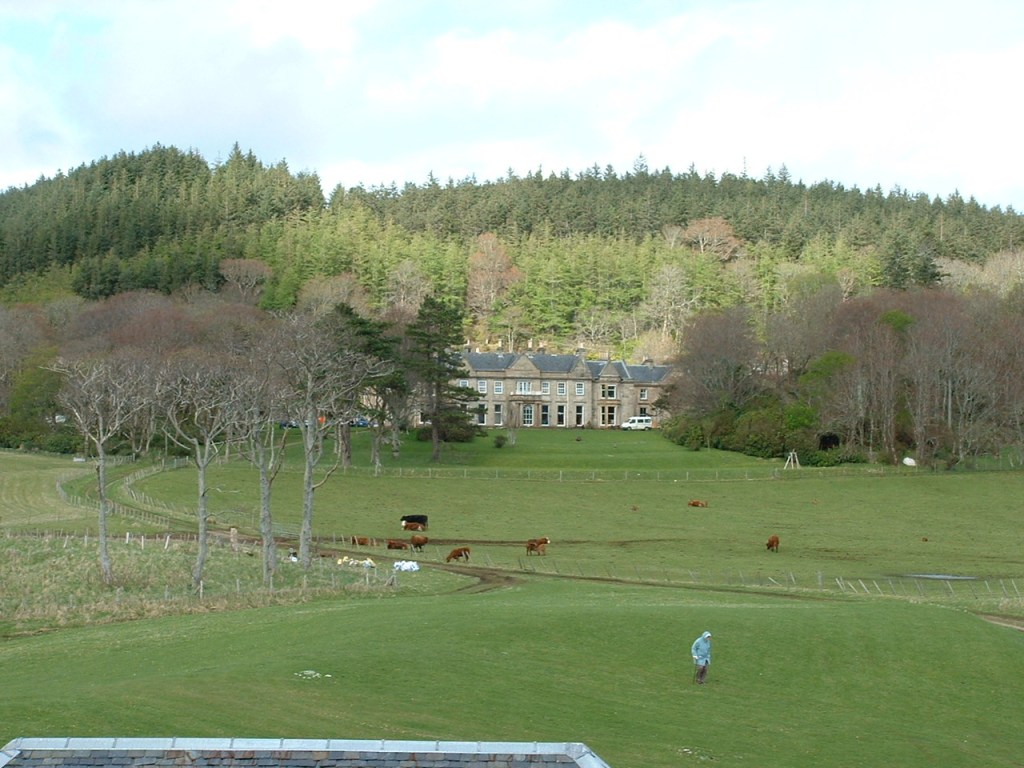
“With the exception of heavy showers of sleet, this has been the best day for a long time” (March 28 1859)
Between 1851 and 1869, Mr. T. Bunning, the butler who worked for Mr. Rainy at Raasay House, recorded details about the weather; the work on the estate;, the sermons preached by the ministers; the arrival (or not) of boats bringing mail and supplies; the emigration of people; and other events in a series of “Weather Books” that are now held in the National Archives of Scotland (MET 1/4/18/43, MET 1/4/18/2/2, 1/4/18/2/3, 1/4/18/2/4) I am fascinated by these documents! Here’s what I love about them: they are like diaries, recording mundane day to day things like the temperature and when the first dish of peas is picked, and whether the mail boat could arrive. These are things that we would notice day to day…but are rarely available in normal records, I think… They also give us a hint of how things change on the estate – the beginning of it being a hunting retreat rather than working estate, the development of the sheep farm, ‘visitors…’ and the ‘working people’ who do the hay and corn work…They record momentous events like the clearance of Fearns with some emotion, but also with details that I haven’t seen elsewhere – the provision of shoes, baskets of food, clothing, medical care, and the taking of statements
Looking at these books gives us an immediate kind of picture of the activities on the estate, and the day to day conditions under which people worked. They raise questions about how people whose work is described in the brief comments experienced their days, how they managed their work, and how the island was both remote and connected to the rest of the world.
Weather.
Mr. Bunning somewhat erratically recorded rainfall, temperature, wind direction and speed, and storms. He used instruments to measure temperature, barometric pressure (both a barometer and a sympiesometer, a type of lightweight barometer), and wind direction. The overall impression is one of very changeable weather, with quite frequent storms, particularly in the winter, that inhibited the movement of people, the arrival of ships to bring supplies or mail, and the work that needed to be done on the estate. On the other hand, many spring and summer days are described as “fine growing days’ or ‘very hot (with high temperatures 65-67 degrees F: for example, May 29-30, 1859).
Snow was frequent in the winter, and indeed could fall anywhere between October and May. “Severe winter weather – a great fall of snow, temperatures 28-34” (October 22, 1859) “Snow in the hills.” (April 5, 1856). “Planting stopped on account of hard frost, snow” (March 16-18, 1853.)
Rainfall over this period averaged 73.19 inches a year, though there were six years with total rainfall over 80 inches, including 1868 when 98 inches of rain fell in Raasay. Four years saw rainfall of less than 60 inches. More important than total rainfall for the agricultural year seems to have been timing of rainfall. Most rain falls in winter; in 1859, despite annual rainfall of 74.7 inches, the hay crop was a failure due to “…the long duration of dry weather.” (July 22, 1859) In that year, there was less than one inch of rain in May, and only 2-3 inches in June and July; while January –March had about 30 inches, and Aug-Dec about 32 inches, including significant snow in October and December.
Winter storms often made it impossible for the boat carrying post to cross to Raasay from Skye for days, sometimes a couple of weeks, at a time.
What he finds it important to record.
Bunning frequently notes when the first dish of peas from the garden or first strawberries or cherries are picked. These new fresh springtime fruits must have been particularly welcome. Peas might arrive any time from early June (June 4 in 1851) to mid July (July 18, 1860), and strawberries around the same time (June17 1853, July 3, 1858). These are harvested from the Raasay House gardens, which were walled, and no doubt had a milder micro-climate than the open fields and gardens in townships. Today, the walled garden (https://www.facebook.com/RaasayCommunityGardens) is again producing fruits and vegetables, which are sold in the Raasay Community Stores.
Mr.Bunning also mentions deliveries of supplies: coal for heating the house; lime for agriculture, and perhaps for building, and various foodstuffs and seeds. For example, on May 16, 1851, 2 hind quarters of beef and two casks of beer were delivered from Sligachan. Mr. and Mrs. Rainy arrived for a visit nine days later. July 28-29 of that year, there was an eclipse, and the boat delivered cornmeal, brandy, sugar and charcoal.
Other daily events and accidents show up from time to time in the notes. Horses fall from the road; carts and horses fall into drains, the first cuckoo is heard (May 3, 1853), sheep are transported to and from the island. We see mention of slaters and painters working on Raasay House, and other construction on the estate: May 26, 18, 1854: “First stone of the new quay laid.”
Emigration.
The Weather Books give us some details of the arrangements made for people of Fearns to ‘emigrate’ in 1852. On March 26, a ‘fine cold day with some snow and sleet’ a Mr. Macdonald came from Skye to meet with people from Fearns and “take the statements of such as wish to emigrate.” The next day, the steamer brought breadbaskets and clothes for the emigrants. In April, Macdonald came to fill out papers for the emigrants, and to vaccinate them. Clothing was distributed to them in April and May, and on May 6, the first six families left for Australia. Others followed: June 2 ‘Widow Flora McLeod, Upper Fearns, with her 3 sons and 2 daughters left Raasay to Islay steamer for Glasgow as emigrants to Australia.” June 24: “12 families in all 79 souls left Raasay for Sygnet steamer for Glasgow as emigrants to Australia. The Signet came into Raasay bay at ½ past 2:00 pm and in 15 minutes the emigrants were all comfortable on board.”
Of course, what we see are Mr. Rainy’s butler’s perspective on the emigration, here, and not what the ‘emigrants’ thought about the matter! Did they welcome the chance to seek a new life in Australia, along with new clothes, some medical care, and food? Or did they despair that they were forced to leave the homes they had known all their lives?
 Raasay Archaeology